


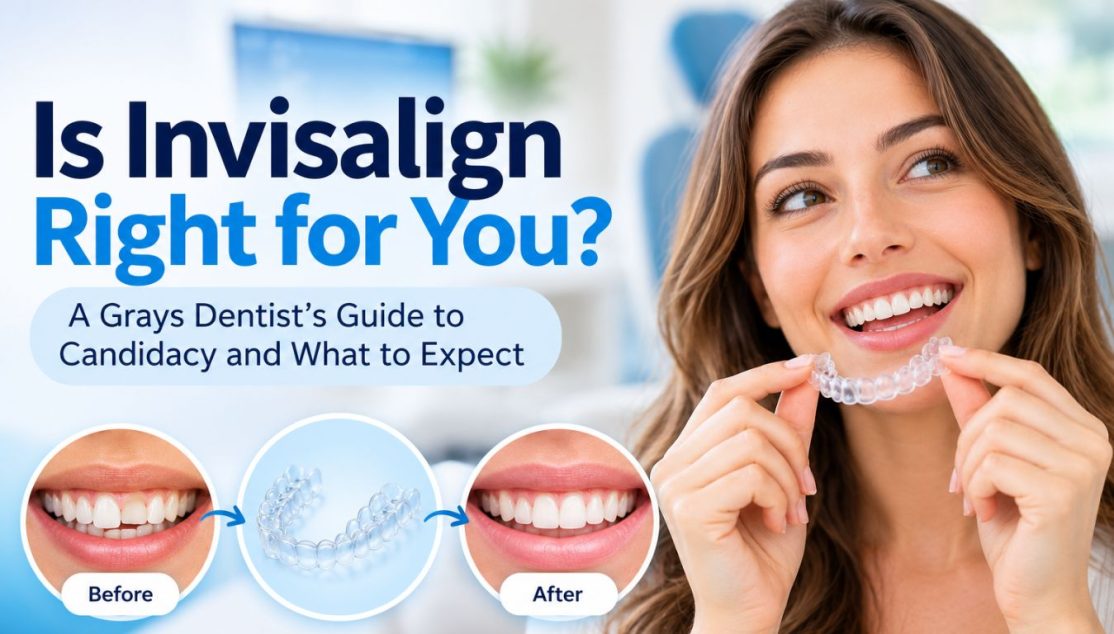
Somewhere between disliking your smile in photos and actually doing something about it, most people hit the same wall: metal braces sound like a lot, for a lot longer than you’d like. That’s usually where Invisalign enters the conversation — discreet, removable, and a genuinely different experience to traditional braces.
But “discreet and removable” doesn’t automatically mean “right for you”. Here’s how the team at Diamond Dental Care in Grays helps you work out who Invisalign actually suits, what treatment looks like day to day, and whether it’s the right call for your smile.
In short: a series of clear, custom-made, removable aligner trays that gradually shift your teeth into position, each one slightly different to the last. You’ll find the full detail on our Invisalign page — here, we’re focused on whether it’s actually a fit for you.
Common Cases Invisalign Can Treat
Invisalign tends to work well for mild-to-moderate crowding, gaps between teeth, and minor bite issues — the kind of thing that bothers you in photos more than it affects how your mouth functions day to day.
When Invisalign May Not Be the Best Option
It’s not the right tool for every job, though. Severe crowding, more complex bite corrections, and certain jaw alignment issues are usually better suited to traditional braces, which can apply a different kind of force that clear aligners aren’t built for. That’s not a failure on your part — it’s just a different starting point needing a different solution.
Age and Lifestyle Considerations
Invisalign suits teens and adults alike, but the deciding factor is rarely age — it’s discipline. The trays only work if you actually wear them for 20–22 hours a day, so if you know you’ll be tempted to leave them out “just for today” more often than not, that’s worth being honest with yourself about before you commit.
The Consultation and Assessment Process
It starts with a consultation: a digital scan or X-ray, an assessment of whether you’re a good candidate, and a treatment plan built around your specific case — including roughly how many aligners you’ll need and how long treatment is likely to take.
Daily Wear and Care Routine
Once treatment starts, the routine is fairly simple: aligners in for 20–22 hours a day, removed only for eating, drinking anything other than water, and brushing. You’ll clean the aligners themselves regularly too, so they stay clear rather than cloudy.
Treatment Timeline and Check-Ins
Treatment length varies by case, but most people move through a series of aligners over several months, with regular review appointments to check progress and hand over the next set in the sequence.
Finishing your last aligner isn’t quite the end — teeth have a habit of drifting back if you let them, so retention matters. We’ll talk you through retainer options once treatment wraps up, including removable, Vivera, and bonded retainers, with full pricing on our fees page.
As a quick recap, Invisalign is generally a good fit if:
If any of that doesn’t quite sound like you, particularly more complex bite or jaw concerns, it’s worth having that conversation at a consultation rather than ruling it out (or in) based on guesswork.
The honest answer to “is Invisalign right for me” is: it depends on your teeth, your bite, and your lifestyle — which is exactly what a proper assessment is for. Book an Invisalign consultation with Diamond Dental Care, Greys, and we’ll give you a straight answer, not a guess.
Call us on 01375 373 409, WhatsApp 07832 639 145, or get in touch with our team to book.
Back to Blog

“Diamond Dental Care is so welcoming and friendly that you don't actually feel…”
“My first point of contact was Alison. She was brilliant and made me…”
“Amazing service. The staff I have met are all super friendly. I could…”
“I contacted Diamond Dental because I was in a lot of pain with…”
“I don’t usually write reviews but Neel at Diamond Dental Group was amazing…”


 279 Rectory Road, Grays, Essex, RM17 5SW


